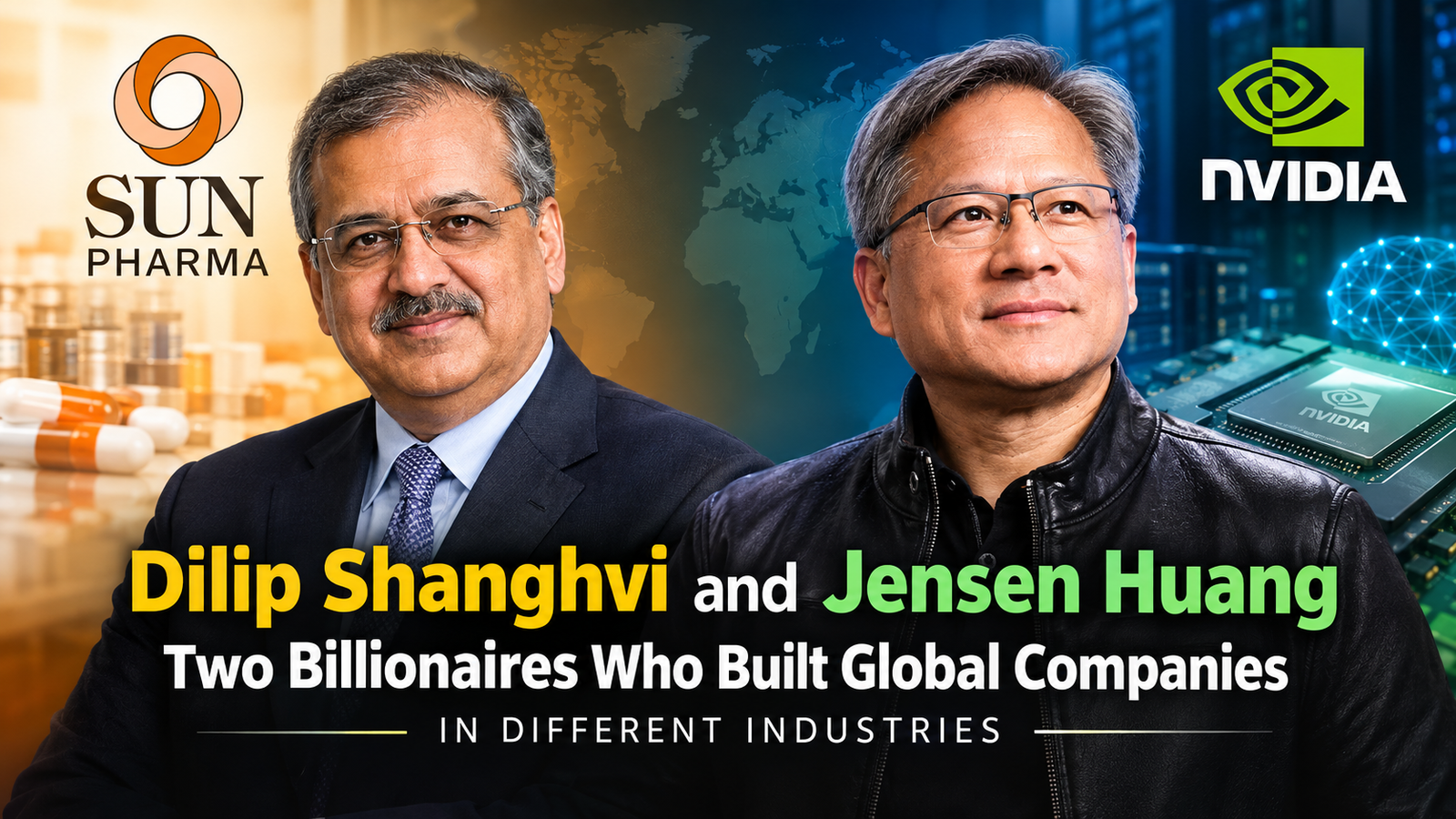
Dilip Shanghvi and Jensen Huang are two influential business leaders who built global companies from very different starting points. Shanghvi built Sun Pharmaceutical Industries into a major international pharmaceutical business, while Huang co-founded NVIDIA and helped transform it from a graphics-chip company into a leading force in accelerated computing and artificial intelligence.
Their stories are often compared because both founders turned relatively focused business ideas into companies with worldwide influence. However, their paths are not alike. Shanghvi’s career developed around pharmaceuticals, acquisitions, healthcare markets, and international expansion. Huang’s career has centered on semiconductor engineering, GPUs, software ecosystems, and successive waves of computing technology.
Looking at their backgrounds, companies, milestones, wealth, and strategies provides a more useful comparison than simply putting two billionaire names side by side.
Dilip Shanghvi and Jensen Huang at a Glance
| Category | Dilip Shanghvi | Jensen Huang |
|---|---|---|
| Company | Sun Pharmaceutical Industries | NVIDIA |
| Industry | Pharmaceuticals and healthcare | Semiconductors, computing and AI |
| Company founded | 1983 | 1993 |
| Current role | Executive Chairman, Sun Pharma | Founder, President and CEO, NVIDIA |
| Education | University of Calcutta | Oregon State University and Stanford University |
| Core growth path | Pharmaceuticals, acquisitions and global expansion | GPUs, accelerated computing, software and AI |
| Major milestone | Sun Pharma’s expansion and Ranbaxy acquisition | GPU, CUDA and AI computing evolution |
The contrast is important. These are not two versions of the same business story. Their companies serve different markets and rely on different forms of innovation.
Who Is Dilip Shanghvi?
Dilip Shanghvi is the founder and Executive Chairman of Sun Pharmaceutical Industries Limited, one of India’s best-known pharmaceutical companies.
He started Sun Pharma in 1983 with a small amount of capital borrowed from his father. Forbes reports that the initial business focused on psychiatric medicines. From that modest beginning, Shanghvi expanded the company through product development, international growth, and acquisitions.
His educational background was in commerce at the University of Calcutta. Before building Sun Pharma, he had exposure to the pharmaceutical distribution business through his family.
That experience gave him an early understanding of how medicines moved through the market. He later applied that commercial knowledge to building a pharmaceutical manufacturer rather than remaining only on the distribution side.
Sun Pharma’s development became much larger than its original domestic business. The company now operates across multiple markets and has businesses spanning generic medicines, specialty products, and other healthcare areas.
Sun Pharma’s official board currently lists Shanghvi as Executive Chairman, while Kirti Ganorkar serves as Managing Director.
Who Is Jensen Huang?
Jensen Huang is the founder, President and CEO of NVIDIA.
He co-founded NVIDIA in 1993 with Chris Malachowsky and Curtis Priem. The original vision focused on 3D graphics for gaming and multimedia, but the company’s technology eventually expanded far beyond those markets.
Huang has an engineering background. He earned a bachelor’s degree in electrical engineering from Oregon State University and a master’s degree in electrical engineering from Stanford University. Before founding NVIDIA, he worked at LSI Logic and Advanced Micro Devices.
NVIDIA’s history under Huang is closely connected with several major computing transitions.
The company introduced the GPU in 1999. It later introduced CUDA in 2006, opening GPU parallel processing to scientific and research workloads. NVIDIA also identifies the 2012 AlexNet breakthrough as a major milestone in the development of modern AI.
Huang has remained NVIDIA’s president and CEO since the company was founded.
How Dilip Shanghvi Built Sun Pharma
Shanghvi’s approach to business was not based on creating a massive company overnight.
Sun Pharma began with a relatively focused product portfolio. The business gradually expanded as it entered additional therapeutic areas and markets.
A major part of this expansion came through acquisitions.
One of the biggest examples was Sun Pharma’s 2014 acquisition of Ranbaxy Laboratories. Forbes reports that the transaction was valued at about $4 billion and became a defining part of Sun Pharma’s expansion.
The company continued pursuing strategic acquisitions and specialty healthcare opportunities. In May 2025, Sun Pharma completed its acquisition of U.S.-based Checkpoint Therapeutics for approximately $355 million, according to Forbes.
This history illustrates an important part of Shanghvi’s business strategy: expansion did not depend solely on launching new products internally. Acquisitions also provided a way to add businesses, products, capabilities, and geographic reach.
Sun Pharma has therefore evolved considerably from the company Shanghvi founded in 1983.
How Jensen Huang Built NVIDIA
Jensen Huang’s business journey followed a different path.
NVIDIA started as a company focused on computer graphics. At the time, 3D graphics represented an important opportunity in personal computing and gaming.
The company’s development of the GPU became a crucial turning point.
NVIDIA’s official history records the invention of the GPU in 1999. The company later introduced CUDA in 2006, allowing GPUs to be used for more general parallel computing workloads. In 2012, the AlexNet neural network helped demonstrate the enormous potential of GPU acceleration for deep learning.
These developments changed the role of NVIDIA’s technology.
Instead of being associated mainly with graphics cards, NVIDIA increasingly became part of the infrastructure behind high-performance computing and AI.
That transition is one of the most important differences between NVIDIA’s early identity and its current business.
NVIDIA now describes itself as a leader in accelerated computing and generative AI, with its technology used across areas such as data centers, robotics, scientific computing, gaming, and AI applications.
Sun Pharma and NVIDIA: Why Their Growth Stories Are Different
Comparing the two companies becomes more useful when their industries are considered.
Sun Pharma: Healthcare and Pharmaceuticals
Pharmaceutical businesses operate within highly regulated markets. Product development, manufacturing, approvals, intellectual property, distribution, and patient demand all influence growth.
Sun Pharma’s expansion has therefore involved both organic development and acquisitions.
NVIDIA: Computing and Semiconductors
NVIDIA operates in an industry where technological change can happen very quickly.
Its growth has been linked to graphics, GPUs, parallel computing, data centers, AI, and software ecosystems.
CUDA is particularly important because it helped create a software layer around NVIDIA’s hardware. This allowed developers and researchers to use GPUs for workloads far beyond traditional graphics.
As AI demand expanded, that long-developed ecosystem became increasingly relevant.
The two companies therefore demonstrate different forms of long-term business building: one centered on healthcare products and global pharmaceutical expansion, and the other on computing platforms and technological transitions.
Dilip Shanghvi vs. Jensen Huang: Education and Early Career
Their educational backgrounds also reveal a clear difference.
Shanghvi studied commerce at the University of Calcutta. His early exposure to pharmaceuticals came through his family’s distribution business. Forbes lists his education as a bachelor’s degree from Calcutta University.
Huang studied electrical engineering. He earned his bachelor’s degree from Oregon State University and master’s degree from Stanford University. Before NVIDIA, he worked at LSI Logic and AMD.
Neither path guarantees entrepreneurial success.
Their stories instead show how different forms of knowledge can become valuable when applied to a specific industry.
Shanghvi developed deep commercial and pharmaceutical expertise. Huang developed technical expertise in semiconductor engineering and computing.
Leadership and Long-Term Thinking
One of the most interesting aspects of comparing these two founders is their long association with their companies.
Shanghvi founded Sun Pharma and remains its Executive Chairman. Sun Pharma’s official board profile also highlights his involvement with Sun Pharma Advanced Research Company, which focuses on research and development of new drugs and drug-delivery technologies.
Huang founded NVIDIA and has remained its President and CEO since 1993.
Their long tenures provide continuity, but their businesses have also had to change.
Sun Pharma expanded geographically and through acquisitions.
NVIDIA moved from PC graphics toward programmable GPUs, accelerated computing, and AI.
That ability to adapt matters because neither company remained exactly what it was at the beginning.
Major Milestones in Their Careers
Dilip Shanghvi
Some important milestones include:
- 1983: Founded Sun Pharmaceutical Industries.
- 1990s onward: Expanded the company into additional therapeutic and international markets.
- 2014: Sun Pharma agreed to acquire Ranbaxy Laboratories in a transaction worth about $4 billion.
- 2016: Shanghvi received the Padma Shri for contributions to Indian trade and industry.
- 2025: Sun Pharma completed its acquisition of Checkpoint Therapeutics.
- 2025: Shanghvi became Executive Chairman as Kirti Ganorkar became Managing Director.
Jensen Huang
Huang’s career includes several technology milestones:
- 1993: Co-founded NVIDIA.
- 1999: NVIDIA introduced the GPU.
- 2006: NVIDIA introduced CUDA.
- 2012: NVIDIA technology powered the AlexNet breakthrough in deep learning.
- 2018: NVIDIA introduced RTX technology for real-time ray tracing.
- 2020s: NVIDIA’s GPUs became central to the rapidly expanding AI-computing market.
These timelines show how differently their companies evolved.
Sun Pharma expanded by adding products, markets, and businesses. NVIDIA expanded by repeatedly finding new applications for its computing technology.
Dilip Shanghvi and Jensen Huang Net Worth
Net worth figures should be treated as time-sensitive estimates, not permanent facts.
Forbes listed Dilip Shanghvi’s real-time net worth at $26.4 billion as of September 10, 2026. Forbes listed Jensen Huang at $187.4 billion as of September 16, 2026.
These numbers can move substantially because both fortunes are connected largely to ownership in publicly traded companies and changes in market value.
For example, Forbes has published different real-time figures for Huang within the same month, illustrating why an article should always attach a date to a net-worth figure rather than treating it as fixed.
It is also important to distinguish personal net worth from company revenue, market capitalization, or cash holdings. These are separate financial concepts.
Are Dilip Shanghvi and Jensen Huang Related?
There is no established public evidence that Dilip Shanghvi and Jensen Huang are family members or that they founded a company together.
Their names are generally discussed together because both are prominent founders associated with globally significant businesses.
Their professional connections are also not the main story. Shanghvi is primarily associated with pharmaceuticals and healthcare through Sun Pharma, while Huang is associated with semiconductors, accelerated computing, and AI through NVIDIA.
Therefore, their comparison is best understood as a comparison of two entrepreneurial journeys, not a story about a shared business partnership.
What Do Their Business Journeys Have in Common?
Despite operating in unrelated industries, several themes appear in both careers.
Long-Term Commitment
Both founders stayed involved with their companies for decades.
Shanghvi founded Sun Pharma in 1983, while Huang co-founded NVIDIA in 1993 and has remained its CEO since its inception.
Strategic Adaptation
Neither company remained limited to its earliest business model.
Sun Pharma expanded its pharmaceutical portfolio and international presence.
NVIDIA moved from graphics into broader accelerated computing and AI.
Industry Knowledge
Their backgrounds are different, but both developed strong knowledge of the industries they entered.
Shanghvi came from a pharmaceutical distribution environment and built a healthcare business.
Huang trained as an engineer and entered the semiconductor industry before founding NVIDIA.
Building for Future Demand
Both companies invested in areas that could support long-term growth.
For Sun Pharma, that has included specialty medicines, research, and acquisitions.
For NVIDIA, it has included GPUs, CUDA, accelerated computing, and AI infrastructure.
What Makes Their Stories Different?
The biggest difference is the nature of their businesses.
Sun Pharma’s products ultimately operate within healthcare systems and pharmaceutical regulations. Its growth depends on factors such as drug portfolios, manufacturing, regulatory approvals, research, pricing, and international markets.
NVIDIA operates in a technology environment shaped by chip architecture, software ecosystems, computing demand, and rapid innovation.
Their approaches to expansion also differ.
Shanghvi’s story contains major acquisition-led milestones, including Ranbaxy.
Huang’s story is strongly associated with technological platform development, especially the evolution of GPU computing.
Neither approach can simply be copied into another industry. What worked for a pharmaceutical company does not automatically work for a semiconductor company.
Lessons Entrepreneurs Can Take From Their Careers
The careers of Dilip Shanghvi and Jensen Huang offer several practical lessons.
Start With a Specific Opportunity
Sun Pharma began with a focused pharmaceutical business. NVIDIA began with a focus on 3D graphics.
A company does not necessarily need to begin with a huge market footprint.
Keep Looking for the Next Use of Your Capabilities
NVIDIA’s GPUs eventually became useful for far more than graphics.
This demonstrates the value of understanding what a technology can do beyond its original purpose.
Growth Can Come From More Than One Source
Sun Pharma’s history shows how acquisitions can accelerate expansion when they fit a broader business strategy.
Build Capabilities That Can Last
CUDA is a strong example of a technology ecosystem that extended the usefulness of NVIDIA hardware across multiple computing applications.
In pharmaceuticals, research capabilities and a diversified product portfolio can similarly support long-term development.
Adapt Without Losing the Core Business
The most interesting part of both stories is not simply that their companies grew. It is that they expanded while remaining connected to their original areas of expertise.
Frequently Asked Questions
Who is Dilip Shanghvi?
Dilip Shanghvi is the founder and Executive Chairman of Sun Pharmaceutical Industries, a major Indian pharmaceutical company. He founded Sun Pharma in 1983.
Who is Jensen Huang?
Jensen Huang is the founder, President and CEO of NVIDIA. He co-founded the company in 1993 and has led it since its inception.
Are Dilip Shanghvi and Jensen Huang business partners?
There is no established public evidence that they are business partners. Their names are generally compared because they are prominent entrepreneurs who built major companies in different industries.
Which industries do they operate in?
Shanghvi operates primarily in pharmaceuticals and healthcare through Sun Pharma. Huang operates in semiconductors, accelerated computing, and artificial intelligence through NVIDIA.
What is Jensen Huang’s educational background?
Huang earned a bachelor’s degree in electrical engineering from Oregon State University and a master’s degree in electrical engineering from Stanford University.
What is Dilip Shanghvi’s educational background?
Shanghvi studied at the University of Calcutta, with Forbes listing his education as a bachelor’s degree from Calcutta University.
How did Sun Pharma become a major company?
Sun Pharma grew through pharmaceutical products, international expansion, and acquisitions. One of its most significant transactions was the 2014 acquisition of Ranbaxy Laboratories.
How did NVIDIA become important to AI?
NVIDIA’s GPUs were originally associated strongly with graphics, but GPU parallel processing became useful for machine learning and AI. CUDA and later deep-learning developments helped expand the role of NVIDIA technology in computing.
Conclusion
Dilip Shanghvi and Jensen Huang built their careers in completely different industries, but their stories share a broader entrepreneurial lesson: successful companies can evolve far beyond their original starting points.
Shanghvi took a small pharmaceutical venture founded in 1983 and developed Sun Pharma through product expansion, international growth, and major acquisitions. Huang co-founded NVIDIA in 1993 and helped guide its transformation from a 3D-graphics company into a major platform for accelerated computing and AI. Click here for more information.
Their differences are just as valuable as their similarities. One story centers on healthcare and pharmaceuticals; the other centers on semiconductors and computing. One grew significantly through acquisitions; the other expanded through technological platforms and new computing applications.
That is what makes the comparison useful. Dilip Shanghvi and Jensen Huang show that there is no single route to building a global company. Long-term thinking, industry knowledge, strategic adaptation, and the willingness to develop new capabilities can take very different forms depending on the market.